SNEAK PEEK: NASA’s 2026 Human Lander Challenge
Full Challenge Details will be available by August 29th!
NASA's Human Lander Challenge (HuLC)
NASA’s Human Lander Challenge (HuLC) is an initiative supporting NASA’s Exploration Systems Development Mission Directorate’s (ESDMD’s) efforts to explore innovative solutions for a variety of known HLS challenge areas. Through this competition, college students contribute to the advancement of HLS technologies, concepts, and approaches. Improvements in these technology areas have the potential to revolutionize NASA’s approach to space exploration, and contributions from the academic community are a valuable part of the journey to discovery. HuLC is open to teams comprised of full-time or part-time undergraduate and/or graduate students at an accredited U.S.-based community college, college, or university. HuLC projects allow students to incorporate their coursework into real aerospace design concepts and work together in a team environment. Interdisciplinary teams are encouraged.
2026 Challenge Theme: Long Duration Spaceflight Environmental Control Life Support System (ECLSS)
As human exploration pushes beyond low Earth orbit toward sustained lunar presence and future missions to Mars, the role of Environmental Control and Life Support Systems (ECLSS) becomes increasingly vital. Designing ECLSS for deep space is uniquely challenging due to mission duration, limited resupply, and extreme environmental conditions.
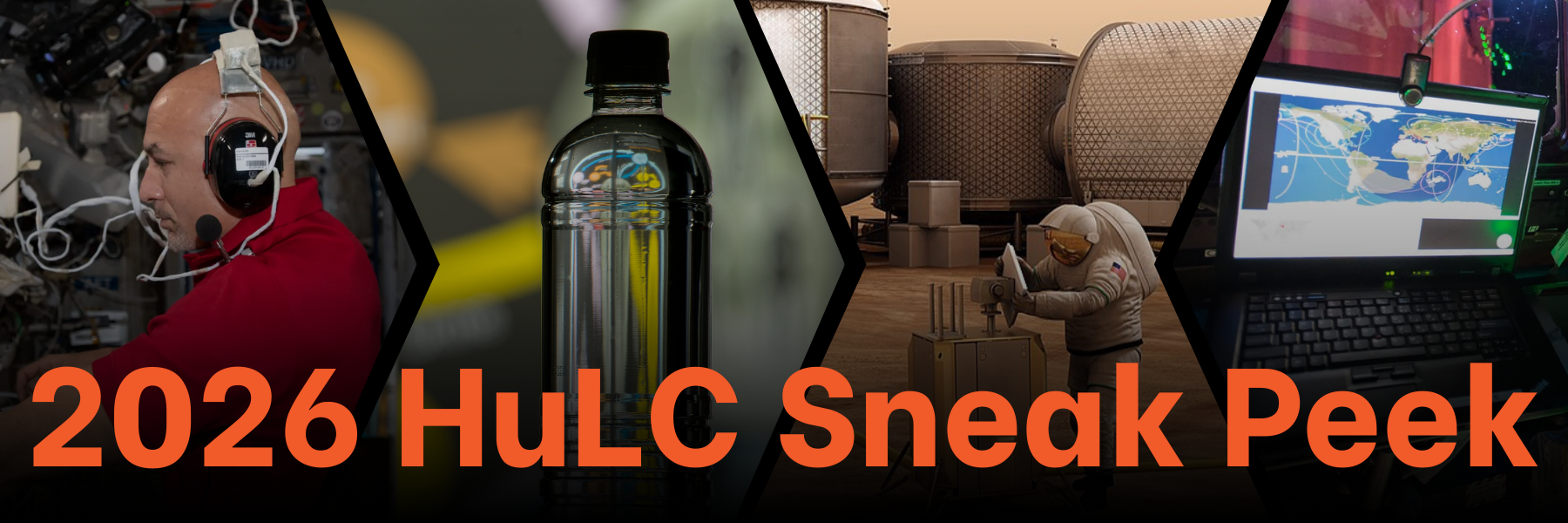
NASA's 2026 Human Lander Challenge (HuLC) invites collegiate student teams to develop innovative, systems-level solutions that improve critical aspects of Environmental Control Life Support System (ECLSS) performance, in response to one of the following subtopic areas:
- Noise Suppression and Control: Currently, fans and other ECLSS hardware on the ISS create loud, pervasive background noise. Future long-duration missions require more effective noise mitigation strategies to support crew health, communication, and overall mission success. Teams should propose innovating concepts to reduce, isolate, or manage noise generated by ECLSS systems in long-duration space habitats (long term lunar stays or human missions to Mars).
- Sensor Reduction in Hardware Health Monitoring Systems: Current space systems monitor hardware health using a multitude of sensors to closely track and assess critical hardware performance, and reporting status to the crew. This approach is effective, but increases the overall mass, power usage, and system complexity. Future missions to the Moon or Mars require more efficient ways to monitor the health of ECLSS hardware with fewer sensors. Teams should propose solutions that lead to mass and power savings by increasing sensor capacity, capability, efficiency, or reliability of hardware health monitoring systems while reducing the total number of sensors required.
- Potable Water Dispenser: Potable water dispensers are necessary to rehydrate dry foods and prepare beverages in microgravity, but current systems are only capable of producing a small amount of heated water and no cold water. Future astronauts will benefit from a solution that delivers both on demand hot and cold water for daily use. Teams should design a novel potable water dispenser that can safely and efficiently deliver temperature-controlled water for astronauts’ food and beverage needs, emphasizing ergonomics and throughput while minimizing waste and cleaning requirements.
- Fluid Transfer between Surface Assets on the Moon and Mars: Surface assets on the lunar and Martian surface will involve multiple assets which must share or transfer fluids such as water, waste, fuel, and oxygen. Future mission success requires efficient and reliable fluid transfer between these systems despite extreme environmental conditions (reduced gravity, dust, temperature fluctuations, etc.). Teams should propose solutions for safe, reliable, and efficient fluid transfer between surface assets on the Moon and/or Mars, addressing compatibility between assets, leak mitigation, ease of use by astronauts and/or robotic systems, and other unique challenges posed by the environment.
Eligibility
HuLC is open to teams of undergraduate and graduate students at accredited U.S.-based colleges and universities.
Full eligibility guidelines will be available on the website in late-August.
Full eligibility guidelines will be available on the website in late-August.
$126,000 in Total Prizes
In Phase 1, up to 12 teams will earn $9,000 each and advance to Phase 2.
The top 3 Phase 2 winners will split another $18,000 at the HuLC Forum!
Dates and Deadlines
Phase 1
| Date | Description |
|---|---|
| October 24, 2025 12:00 PM (Noon) Eastern | Deadline to Submit Questions in Advance for Q&A Session |
| November 4, 2024 | Q&A Session for Interested Teams |
| OPEN through March 4th, 2026 | Submit a Notice of Intent (NOI) |
| March 4, 2026 | Deadline to Submit a Proposal and 2-Minute Video |
| April 6, 2026 | Teams Notified of Selection Status |
Phase 2
| Date | Description |
|---|---|
| May 20, 2026 | Deadline to Register for Forum and Pay Meal Fee |
| May 27, 2026 | Deadline to Submit a Technical Paper |
| May 29, 2026 | Deadline to Make Hotel Reservations at the HuLC Group Rate |
| June 18, 2026 | Deadline to Submit Presentation Chart Deck and Digital Poster Files |
| June 22, 2026 | Team Check-In at the 2026 HuLC Forum |
| June 23-25, 2026 | NASA's 2026 HuLC Forum in Huntsville, AL |
 BettyLynn Mason
 Arthur Brown
 Chris Brown
 Steve Balistreri
 Zach Bryant
 Kaitlin Oliver-Butler
 Leon Chen
 Monica Guzik
 Juan Valenzuela
 Mark Wollen
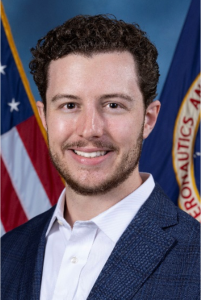 Reid Ruggles
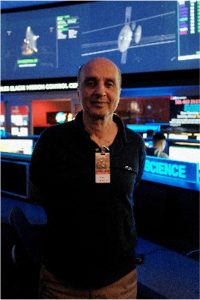 Ali Kashani
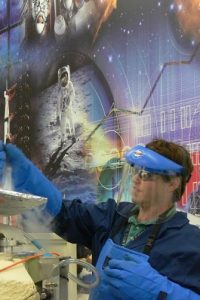 Wesley Johnson
 Ali Hedayat
 Michael Dipirro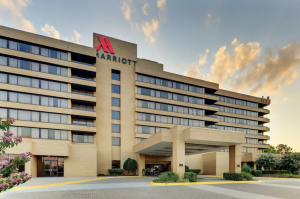
 Jamshid Samareh
 Ashley Korzun
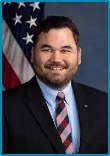 Matt Simon
 Samantha Harris
 Michelle Munk
 Philip Metzger
 Manish Mehta
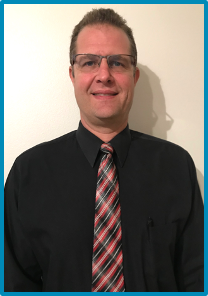 Mark Lewis
 Lora Dishongh
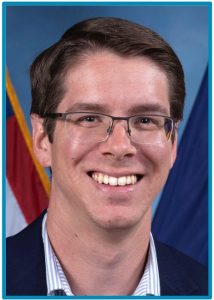 Wesley Chambers
 Esther Lee